
A slender 1-0 lead in favour of PSG separates the two sides heading into the return leg at the Parc des Princes in a week’s time.
It was a tightly contested tactical battle where both teams demonstrated high intensity in attack, but it was Ousmane Dembélé’s superb fourth-minute left-footed strike that ultimately proved to be the difference for the French side.
The early setback disrupted Arsenal’s plans to go full throttle at the Emirates. PSG looked to control the game with sustained possession and a few decent chances to extend their lead. However, Mikel Arteta’s early tactical adjustment around the 20-minute mark—shifting the press from a 4-4-2 to a 4-2-3-1—marked a gradual and meaningful attempt by the Gunners to gain a foothold in the game.
21 mins in, Arteta adjusted Arsenal’s high press.
— Fathalli (@FathalliMo) April 29, 2025
4-4-2 to 4-2-3-1, with Ødegaard shielding central areas. This let the ball-side CM press high while the far-side CM covered the space.
PSG’s rotations and diagonals were less effective after that.
pic.twitter.com/dWL0LnvSyi
Arsenal had their moments, with Martinelli and Trossard testing Donnarumma in both halves, but the Italian’s experience between the posts stood tall. Meanwhile, PSG substitutes Barcola and Ramos squandered golden opportunities to kill the tie—misses that Arsenal will feel fortunate to have escaped unpunished.
As the sides head to France, Arsenal must remain optimistic. PSG hold the advantage not only in scoreline but also with the backing of their home crowd. A game of fine margins is expected, but one that promises plenty of entertainment.
Let’s break down the key talking points from this enthralling UCL semifinal:
PSG’s Suffocating Press
Renowned as one of Europe’s most intense pressing teams, Luis Enrique got the best out of his players at the Emirates. PSG consistently disrupted Arsenal’s short-passing rhythm, pressing aggressively both centrally and wide. This pressure forced the Gunners into errors during buildup, resulting in sloppy giveaways—though none were capitalised upon.
With passing options reduced, Arsenal increasingly relied on David Raya’s ball-playing ability as a GK. Stepping up as a literal central centre-back in possession, Raya attempted long diagonals towards Saka or targeted Merino’s physical presence. This strategy allowed Arsenal to relieve pressure and push higher up the pitch.
PSG’s Build-Up Play:
If you’ve followed PSG this season, their structured buildup won’t surprise you. The sequence leading to Dembélé’s goal showcased their positional play and passing intricacies (utilising diamonds and triangles) to manipulate space.
How did it unfold? Ødegaard and Saka pushed high to press Nuno Mendes, forcing him into a risky pass. With Merino and Rice man-marking Vitinha and Ruiz respectively, Dembélé dropped deeper to exploit the central space and receive the ball. He carried the ball unchallenged, played it wide to Kvaratskhelia, who in turn drew defenders before cutting it back to Dembélé, who finished clinically from the edge of the box.
Ousmane Dembélé with the first-time finish 😮💨@Heineken | #UCLGOTD pic.twitter.com/lnNCbRwB12
— UEFA Champions League (@ChampionsLeague) April 29, 2025
Statistically, PSG completed 26 passes in the buildup to that goal—their highest for a goal in the Champions League this season. For Arsenal, it was also the longest passing sequence leading to a goal they’ve conceded since data became available in 2003/04.
Bukayo Saka in Isolation
Embed from Getty ImagesBefore the match, Philip Lahm outlined the ideal approach to stopping Saka: “Cut off his supply, limit his touches, and block passing lanes—he needs to be isolated.”
Luis Enrique’s side executed this blueprint perfectly. Despite being one of Arsenal’s few consistent attacking threats, Saka was often double- or even triple-marked, significantly limiting his influence. Arsenal failed to find him in more central positions, and they couldn’t effectively exploit the space left elsewhere on the pitch when PSG focused so heavily on him.
Arsenal’s Creative Leader Falls Short
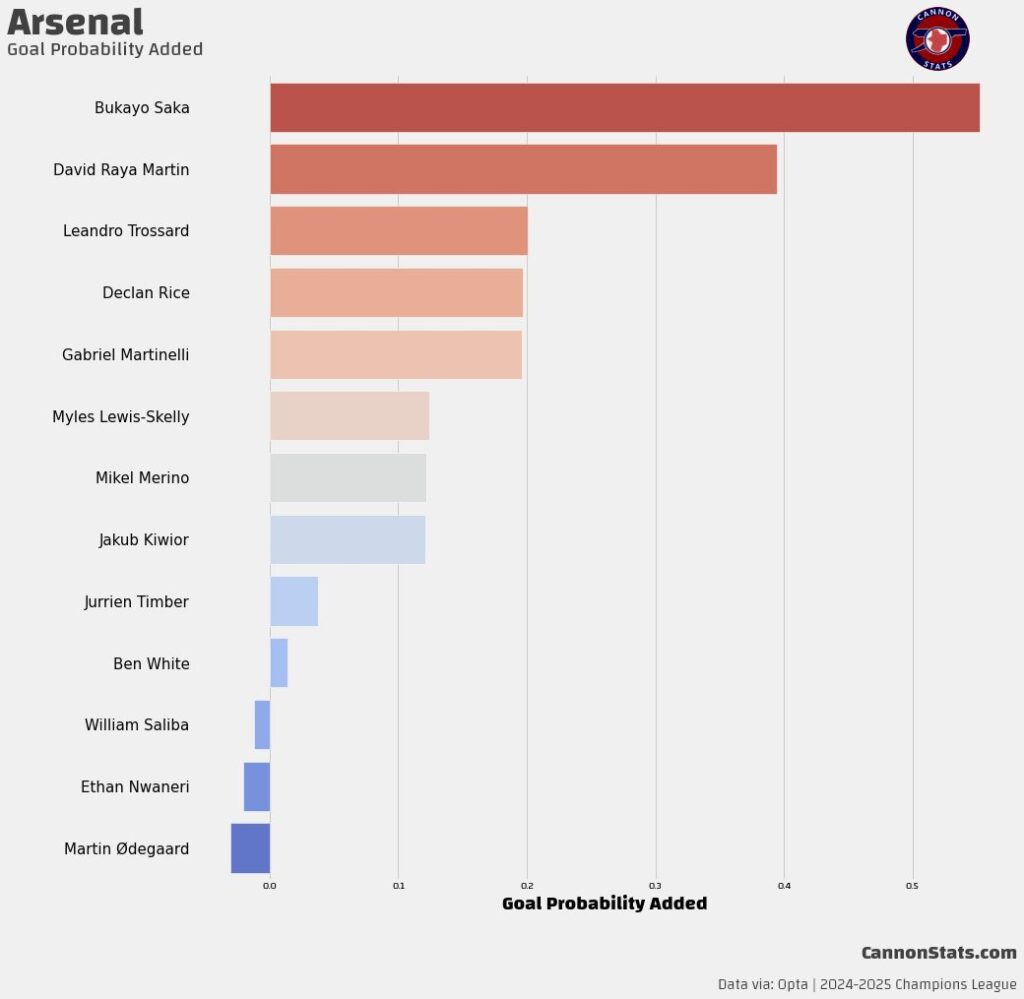
Martin Ødegaard endured one of his most underwhelming performances in an Arsenal shirt. While his off-the-ball pressing and defensive work were commendable, his contributions on the ball fell well below his usual standards.
Credits: Cannon Sats/Scott Willis
Despite the high tempo of the match, Ødegaard managed only one pass into the final third and completed just one of five dribble attempts. He also registered the lowest expected goal contribution among Arsenal’s starters—uncharacteristic numbers for the team’s primary playmaker.
Arsenal’s Lack of Ball-Carrying Threat
PSG’s central ball carriers—Doué, Kvaratskhelia, and Dembélé—consistently offered directness and invention. In contrast, Arsenal lacked such profiles until Myles Lewis-Skelly stepped up.
Inverting from left-back into midfield, Lewis-Skelly attempted to disrupt PSG’s structure by driving forward with close control and physical strength. Declan Rice also tried carrying the ball from deep in the second half, and PSG struggled to contain him.
This highlights a potential area Arsenal can exploit in the second leg—especially if Thomas Partey returns. His inclusion would provide additional ball-carrying strength and midfield thrust, something Arsenal clearly missed in this fixture.